
Flowers
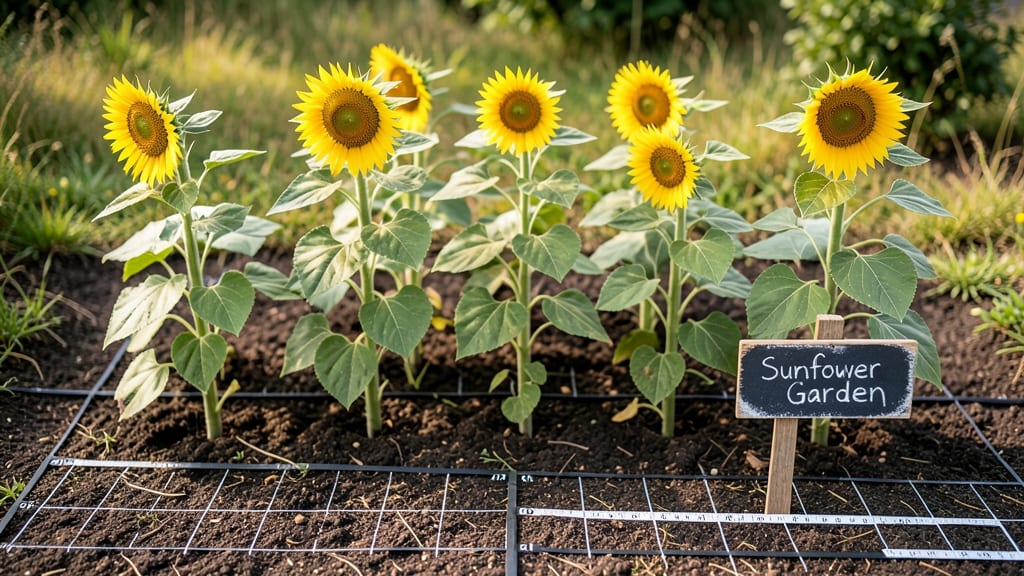
To grow sunflowers per square foot without stunting their towering beauty, aim for 1 to 4 plants depending on their variety and your garden’s conditions.
Picture this: your 🌻 sunflowers stretching toward the sky, their golden blooms catching every ray of sunlight—but instead of thriving, they’re leaning, their leaves yellowing from competition. That’s the sign you’ve planted too many in too little space.
Sunflowers need room to breathe, especially the giants that can reach 14 feet tall. Dwarf varieties might squeeze in at 4 plants per square foot, while standard types need 1 to 2 plants to avoid overcrowding.
Below, I’ll break down the exact spacing for each type, plus how to adjust for soil, sunlight, and even container gardens.
You’ll also discover how to spot the warning signs of poor spacing—like stunted growth or pest problems—and how to fix them before your garden looks like a sunflower jungle. Let’s get those stems standing tall!
Optimal sunflower spacing by variety: dwarf vs. giant sunflowers
Sunflowers aren't one-size-fits-all when it comes to spacing. The variety you choose dramatically impacts how many plants you can fit per square foot. Dwarf sunflowers like 'Teddy Bear' can thrive in tight clusters, while giant varieties like 'Mammoth' need room to spread their roots and avoid toppling.
Understanding these differences helps you maximize your garden's potential without sacrificing plant health or yield.
Spacing isn't just about height—it's also about root competition and air circulation. Tall sunflowers with deep taproots need more space to access nutrients, while dwarf varieties can share resources more efficiently.
Even within the same variety, maturity timing matters—earlier bloomers may need slightly more room to establish before taller varieties cast shade.
For dwarf sunflowers like 'Moulin Rouge' or 'Sunspot', you can fit 4-6 plants per square foot when spaced 8-12 inches apart. This density works perfectly for container gardening or creating vibrant borders.
The key is to plant them in well-draining soil and provide support stakes if they lean toward each other.
Semi-dwarf varieties such as 'Autumn Beauty' or 'ProCut' strike a balance, allowing 2-3 plants per square foot when spaced 12-18 inches apart. These are ideal for cut flower gardens where you want height without sacrificing too much space.
I've found that pairing them with shorter companions like zinnias prevents them from overshadowing nearby plants too soon.
Standard sunflowers like 'Russian Giant' or 'Serenity' require more breathing room—1-2 plants per square foot with 18-24 inches between stems. This spacing prevents root competition and ensures each plant gets enough sunlight, especially as they grow taller.
In my experience, planting them in rows with north-south orientation minimizes shade competition between plants.
Giant sunflowers like 'Mammoth' or 'American Giant' are the divas of the sunflower world, needing at least 36-48 inches between plants—that's 1 plant per square foot or less.
These varieties are best suited for large open spaces or as specimen plants where their dramatic height and size can shine. I once tried planting two giants too close together, and they both leaned toward each other, creating a tangled mess by mid-summer.
Remember that spacing guidelines are just starting points. Factors like soil fertility, water availability, and local climate can influence how closely you can plant.
In rich, well-draining soil, you might get away with slightly tighter spacing, while poor soil or drought conditions may require more room for roots to establish.
Pro tip: If you're short on space, consider succession planting. Instead of planting all your sunflowers at once, stagger them by 2-3 weeks. This way, you can enjoy blooms throughout the summer while maintaining proper spacing.
I've used this technique in my small urban garden to get two harvests of dwarf sunflowers in the same spot.
Always account for wind exposure when spacing taller varieties. In windy areas, give giant sunflowers even more room—up to 48 inches apart—to prevent them from toppling over. You can also stake them early or plant them near a windbreak like a fence or hedge to provide natural support.
Finally, don't forget that sunflowers are heavy feeders. When planting densely, you'll need to fertilize more frequently to prevent nutrient competition. A balanced 10-10-10 fertilizer applied every 4-6 weeks keeps my sunflowers thriving, regardless of their variety or spacing.
How to adjust sunflower spacing for different garden conditions
Your garden's unique conditions—like soil quality, climate zone, or container limitations—can drastically change how many sunflowers you can plant per square foot. In rich, well-draining soil, you might fit more plants, while sandy or rocky soil requires wider spacing to prevent competition.
Even your local rainfall patterns play a role: drought-prone areas need extra room for roots to access moisture.
Container gardening adds another layer—balcony planters or large pots restrict root growth, so you’ll need to adjust spacing downward. Meanwhile, urban gardeners with limited space might opt for dwarf varieties to maximize vertical growth without sacrificing yield.
The key is balancing plant density with their need for airflow and sunlight to prevent disease and maximize those iconic sunflower blooms.
- Standard soil: 1 sunflower per square foot (12" apart). Ideal for most gardeners with average soil and rainfall.
- Poor soil: 1 sunflower per 1.5 sq ft (18" apart). Wider spacing helps roots access nutrients in compacted or nutrient-poor soil.
- Drought-prone areas: 1 sunflower per 2 sq ft (24" apart). Extra space reduces competition for water during dry spells.
- Containers (5+ gallon pots): 1 sunflower per pot. Use dwarf varieties to avoid overcrowding roots in limited space.
- Urban balconies: 1 sunflower per 1 sq ft (12" apart) in shallow planters, or 1 per 2 sq ft in deeper containers.
If you’re growing sunflowers in clay-heavy soil, increase spacing to 18-24 inches apart to prevent root rot and improve drainage. The same rule applies if your area gets high humidity—tighter spacing can trap moisture, inviting fungal diseases like powdery mildew.
For container gardens, choose pots with at least 5 gallons of soil per sunflower to support root growth, even for dwarf varieties.
In hot, arid climates, wider spacing (up to 36 inches apart) helps sunflowers conserve moisture and reduces stress on the plants. Pair this with mulching to retain soil moisture and keep roots cool.
For cooler climates, you can plant slightly closer (12-18 inches apart) since sunflowers won’t face the same water stress, allowing for denser displays without sacrificing health.
Pro tip: Mix companion plants like borage or marigolds between sunflowers to improve soil health and deter pests. This also lets you increase sunflower density slightly (e.g., 1 sunflower per 1.25 sq ft) without overcrowding.
Just monitor for signs of competition—wilting leaves or yellowing stems mean it’s time to thin out.
Remember, sunflowers are forgiving when it comes to spacing adjustments. Start with the guidelines above, then tweak based on your garden’s performance. The goal is healthy stems and vibrant blooms, not perfect rows—so don’t stress if your spacing isn’t exact! 🌻