
Planting
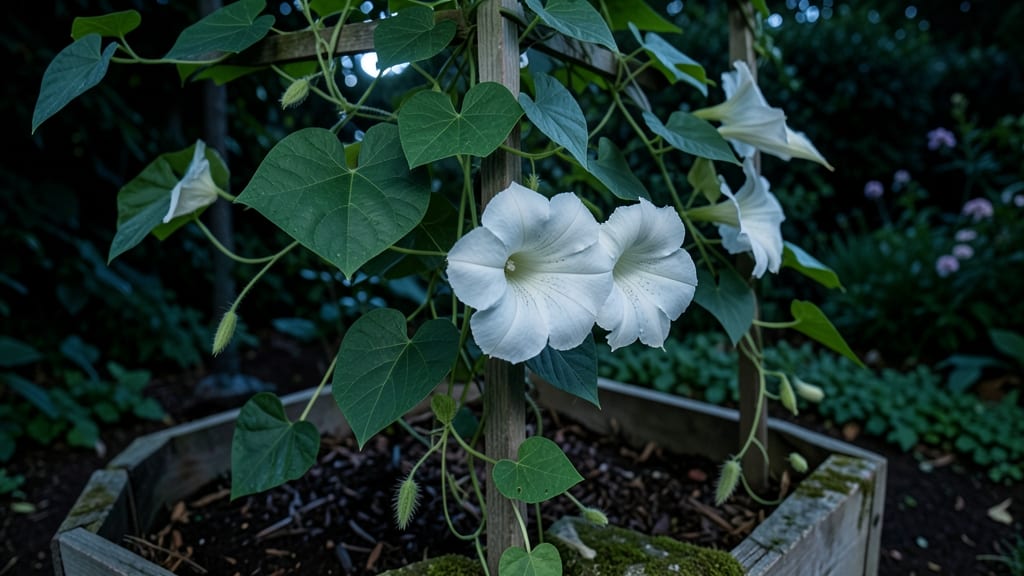
The moonflower plant looks like a dreamy, vine-climbing wonder with giant white blooms that only open at night 🌙 — and its daytime foliage is just as striking.
Imagine a plant that only reveals its breathtaking beauty under the moonlight—each flower the size of a dinner plate, glowing like a ghostly lantern in your garden. The moonflower (Ipomoea alba) is one of nature’s most dramatic night-bloomers, but its daytime appearance is just as fascinating.
By day, you’ll spot its large, heart-shaped leaves and fast-growing vines that can climb up to 20 feet if given a sturdy trellis. The buds resemble oversized white marbles, packed tightly along the stems, waiting for dusk to burst into full bloom.
Below, I’ll walk you through how to spot a moonflower in your garden—from its daytime foliage to its magical nighttime display—and how to tell it apart from lookalikes like morning glory.

Moonflower plant characteristics: how to identify it by day and night
The moonflower (Ipomoea alba) is a stunning vine that transforms your garden into a magical nighttime spectacle. By day, it looks like any other lush, green vine, but its true beauty emerges after sunset.
The plant’s distinctive foliage and growth habits make it easy to identify once you know what to look for—both during daylight hours and under the moonlight.
During the day, moonflowers appear as rapidly climbing vines with heart-shaped leaves that can grow up to 6 inches long. These leaves have a smooth, waxy texture and are arranged alternately along the stem.
The vines themselves are glabrous (hairless) and twining, meaning they coil around supports like trellises or fences to reach their full height of 10 to 20 feet.
Here’s what sets moonflowers apart from other vines—especially when it comes to their buds and flowers. By day, you’ll spot large, closed buds that resemble oversized, pale green or white marbles.
These buds are firm to the touch and can measure 4 to 6 inches in diameter, making them impossible to miss if you’re scanning your garden for something unique.
At dusk, these buds burst open dramatically into giant white flowers that can reach up to 12 inches across. Each bloom has a delicate, almost translucent petal structure and emits a sweet, intoxicating fragrance that attracts nocturnal pollinators like moths and hummingbirds.
The flowers close by mid-morning, leaving behind wrinkled petals that often drop by afternoon.
| Characteristic | Daytime Appearance | Nighttime Appearance |
|---|---|---|
| Leaves | Heart-shaped, 6 inches long, smooth edges, alternate arrangement | Same; no change at night |
| Vines | Hairless, twining, 10-20 feet tall, rapid growth | Same; vines may appear silhouetted against moonlight |
| Flowers | Closed buds, 4-6 inches wide, pale green/white | Fully open, white, 12 inches wide, fragrant, glowing |
| Fragrance | None (buds are scentless) | Sweet, honey-like, attracts pollinators |
| Growth Habit | Fast-climbing vine, needs trellis or support | Same; may glow under moonlight |
The moonflower’s foliage is another key identifier. Unlike some vines that have jagged edges or fuzzy textures, moonflowers boast smooth, glossy leaves with a deep green color. Young leaves may appear slightly lighter in shade, but they darken as the plant matures.
If you run your fingers along the stem or leaves, you’ll notice they’re completely free of hairs, which helps distinguish them from other climbing plants.
One of the most misleading aspects of moonflowers is their buds. Many gardeners assume the large, closed buds are the flowers themselves, but they’re actually pre-bloom structures that only reveal their true form after dark.
These buds are firm and round, almost like green marbles attached to the vine. If you gently squeeze one, you’ll feel its turgid, almost rubbery texture, which is a dead giveaway.
When moonlight hits a fully open moonflower, it creates a mesmerizing effect. The petals appear to glow softly, almost like they’re illuminated from within. This nocturnal magic is why moonflowers are often called "ghost flowers".
During the day, however, the spent flowers wrinkle and droop, often falling off by late morning. This daily cycle is a tell-tale sign that you’re dealing with a true moonflower and not a lookalike.
If you’re trying to identify a moonflower in your garden, pay close attention to the vine’s growth pattern. Moonflowers are aggressive climbers, often reaching 10 to 20 feet in a single season if given proper support.
They’ll twine clockwise around trellises, fences, or even other plants. Unlike some vines that sprawl or root at nodes, moonflowers strictly climb, which is a key difference from plants like morning glories.
Finally, don’t overlook the moonflower’s native habitat as a clue. This plant thrives in tropical and subtropical regions, particularly in USDA Zones 9-11. In cooler climates, it’s often grown as an annual, but it can self-seed prolifically if conditions are right.
If you’re in a warmer zone, moonflowers may rebloom throughout the summer, especially after heavy rains or pruning.
To test
Giant white flowers: the moonflower’s stunning nocturnal display explained
The moonflower’s giant white blooms are nature’s most enchanting nighttime spectacle, unfurling like celestial lanterns when darkness falls. Each flower can reach an astonishing 10-12 inches wide, making them the largest blooms in the Ipomoea family.
Their smooth, waxy petals reflect moonlight beautifully, creating an ethereal glow that attracts night-flying pollinators like moths and hummingbirds.
What makes these flowers truly magical is their nocturnal schedule. They remain tightly closed during the day, preserving their delicate structure, only to burst open at dusk (around 7-8 PM).
This unique behavior isn’t just for show—it’s an evolutionary adaptation to attract night pollinators while avoiding daytime heat and predators. The scent becomes most potent after sunset, releasing a sweet, intoxicating fragrance that can linger in your garden long after the blooms close.
To capture the moonflower’s nocturnal magic, time your photography for 1-2 hours after sunset when the blooms are fully open. Use a tripod and slow shutter speed to capture the soft moonlight illuminating the petals.
For a dramatic effect, include night-flying pollinators like sphinx moths hovering near the flowers—just be sure to use a flashlight with a red filter to avoid startling them.
If you want to attract more pollinators to your moonflowers, plant them near other night-blooming plants like evening primrose or night-blooming jasmine. These combinations create a pollinator buffet that extends the blooming season.
Avoid using chemical pesticides after dusk, as they can harm the very moths and hummingbirds that help your moonflowers reproduce.
One of the most fascinating aspects of moonflowers is their short-lived blooms. Each flower lasts only 1-2 nights before wilting by dawn, making every evening a unique spectacle. This ephemeral nature encourages gardeners to plant multiple seeds for a continuous display throughout the summer.
The vines themselves are also stunning—thick and robust, they can climb trellises, fences, or even arbors with ease.
For the best results, grow moonflowers in full sun (6+ hours daily) with well-draining soil. Their rapid growth and vining habit make them perfect for adding vertical interest to gardens, balconies, or even container setups with sturdy supports.
With the right conditions, your garden will become a nocturnal paradise that rivals any moonlight garden you’ve ever seen. 🌙🌿